The Monobloc Chair. How a piece of furniture took over the world.
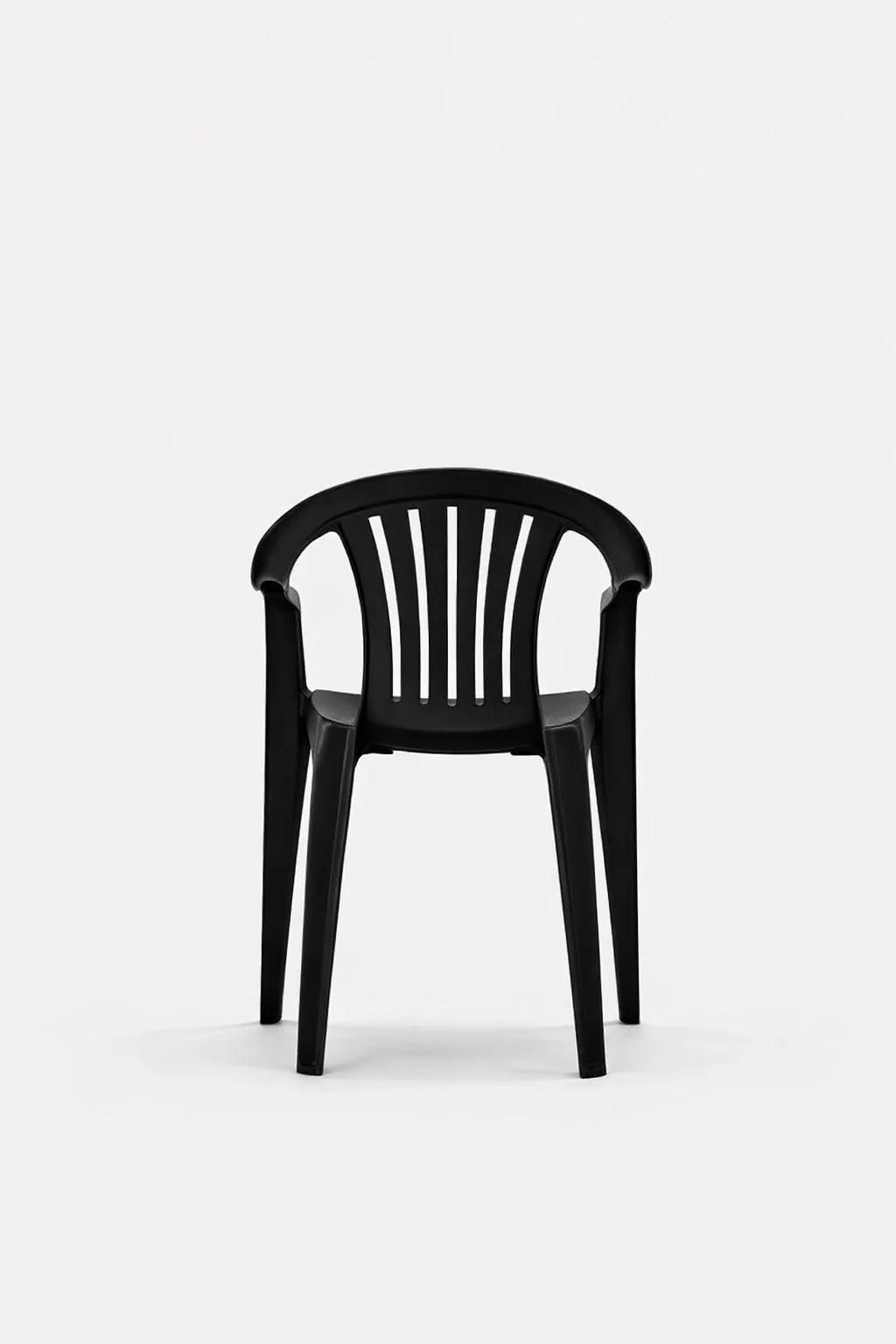
The Monobloc Chair. How a piece of furniture took over the world.
The monobloc chair rarely announces itself. It does not signal taste, wealth, or belonging. And yet, it is almost impossible to avoid. Across continents and cultures, this lightweight plastic chair appears at weddings and funerals, in schoolyards and cafés, at polling stations, beaches, and construction sites. It may be the most widely shared physical experience of sitting in human history.
That very ordinariness is what makes the monobloc remarkable.
Familiar to everyone, claimed by no one
Unlike most designed objects, the monobloc does not anchor itself to a place or a moment in time. A photograph containing one gives away almost nothing: not the decade, not the country, not the social context. This absence of identity has led scholars such as Ethan Zuckerman to describe it as a context-free object, a product so globally distributed that it dissolves geographic and cultural clues.
Paradoxically, this universality has also made it controversial. In cities that prize visual coherence and historical character, the monobloc has been seen as an intrusion. In Basel, for example, it was once banned from restaurant terraces because it was considered detrimental to the urban image. Few pieces of furniture have ever been regulated by law simply for how they look.

Elderly men sitting outside of shop, Ragusa, Sicily, Italy
Chairs as cultural indicators
Chair design has long functioned as a testing ground for new ideas. From handcrafted wooden seating to tubular steel experiments and expressive postwar plastic forms, chairs have mirrored technological progress and social ambition. They often embody the ideals of their time: efficiency, optimism, futurism, or rebellion.
The monobloc breaks from this lineage. It does not try to symbolize progress or express a philosophy. It does not challenge how we sit. Instead, it quietly fulfills a brief so basic that it almost disappears: provide a seat, cheaply, reliably, and everywhere.
From design experiment to industrial formula
The monobloc did not appear fully formed. Early attempts at one-piece seating date back to the mid-20th century, when designers began exploring plastics as a serious furniture material. Initial concepts were bold but impractical, either too expensive or too complex to manufacture at scale.
The turning point came with injection molding. When designers such as Verner Panton demonstrated that a chair could be molded from a single piece of plastic and still remain stable and stackable, the technical groundwork was laid. Although the Panton Chair was a high-end design object, it proved that seamless plastic furniture was feasible.
Industrial optimization followed. In the early 1970s, Henry Massonnet refined the process to an extreme, compressing production time and eliminating unnecessary complexity. Without patent protection, the design logic spread rapidly. By the 1980s, factories across the globe were producing their own versions, adapted only slightly to local molds and materials.
The logic of the mold
The defining feature of the monobloc is not its appearance but its method of production. Molten polypropylene is injected into a metal mold and cooled into a complete chair, no joints, no screws, no assembly. This single decision explains almost everything about the object.
The upfront cost is enormous: molds are expensive and unforgiving. But once installed, production becomes astonishingly efficient. Labor is minimal, material use is optimized, and output can reach massive volumes. Over time, the chair’s form has been refined by economics rather than aesthetics, arriving at a balance where strength, flexibility, and weight are pushed to their practical limits.
What remains is a chair that is weather-resistant, stackable, light enough to carry with one hand, and strong enough to endure years of use.
The chair between waste and use
The monobloc’s greatest strength is also its biggest liability. Its low cost encourages disposability, contributing to plastic waste and environmental criticism. In some regions, broken chairs are replaced without a second thought.
Elsewhere, the same chair is repaired repeatedly, reinforced with improvised fixes, and used for decades. These contrasting realities reveal that the monobloc is not inherently careless or responsible, it reflects the economic and cultural systems in which it circulates.
Affordability, often dismissed in design discourse, is not a neutral attribute. It determines who gets to sit and who does not. In that sense, the monobloc may be one of the most socially inclusive objects ever produced.
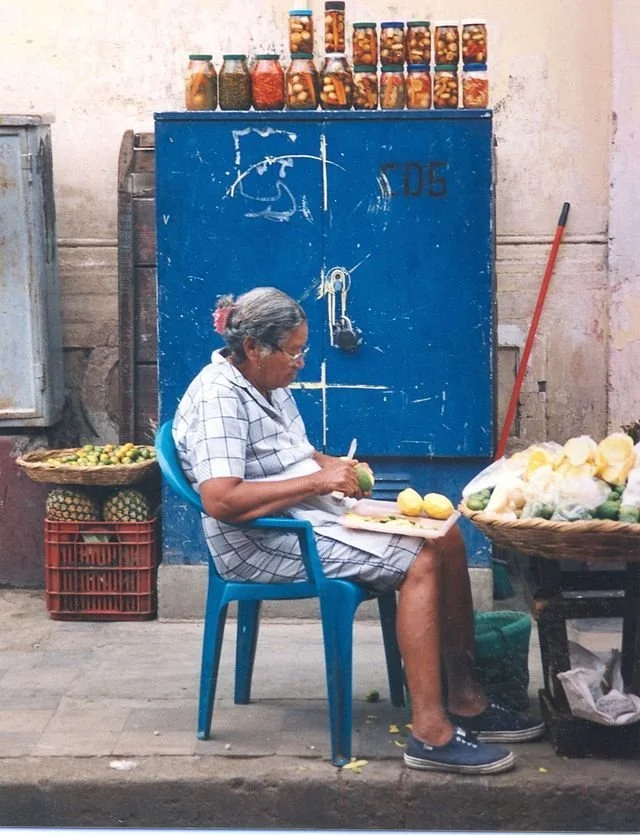
A Nicaraguan street vendor with her food stall in Granada
Rethinking an overlooked object
It is easy to dismiss the monobloc because it is everywhere. Familiarity breeds indifference, and indifference turns into disdain. But when stripped of expectations about style and prestige, the chair reveals a different story—one about efficiency, access, and global circulation.
The monobloc does not ask to be admired. It asks to be used. And perhaps that is why it unsettles us: it fulfills its purpose so completely that it leaves no room for authorship, nostalgia, or identity.
In a world obsessed with differentiation, the monobloc is radically anonymous. Yet precisely because of that, it has become one of the most influential objects of the modern age.